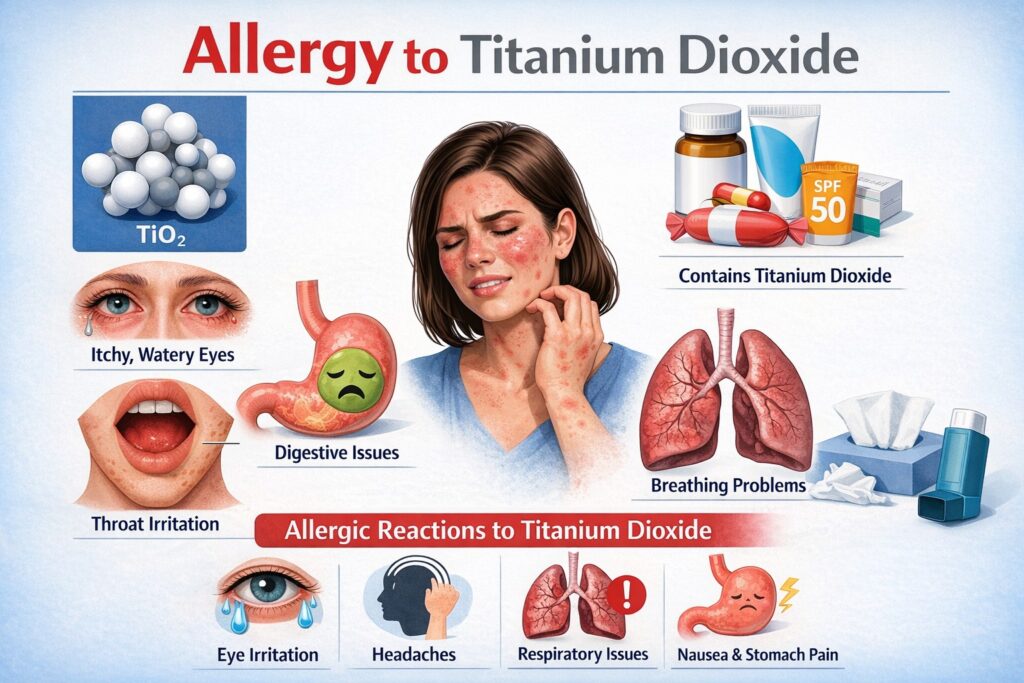
Have you ever had unexplained skin rashes, digestive problems, or strange inflammatory reactions that doctors couldn’t identify? You might have an allergy to titanium dioxide, a common food additive and cosmetic ingredient found in more products than you might think. This seemingly harmless white powder, known as E171 in Europe and just “titanium dioxide” in the United States, could be causing your ongoing health issues.
An allergy to titanium dioxide is more common than many people understand, yet it is often not diagnosed in the medical field. If you might consume or use this substance daily without realizing it, recognizing the warning signs could be crucial to restoring your health.
To help you find out if this widely used compound is affecting you, we will explore 10 key symptoms of an allergy to titanium dioxide in this guide. We will discuss what titanium dioxide is, where it’s commonly found, how allergic reactions happen, and most importantly, how you can protect yourself and your loved ones.
What Is Titanium Dioxide and Why Should You Care?
Before we proceed to the warning signs of an allergy to titanium dioxide, let’s have a brief look at what this compound is and why it is so common in our lives.
The naturally occurring mineral titanium dioxide (TiO2) has been processed into a white powder. It is used as a pigment and whitening agent in thousands of products. The food industry is particularly fond of it because it makes products appear whiter and more attractive. Due to its opacity and ability to block UV rays, the cosmetic industry uses it.
Common Products Containing Titanium Dioxide
You’ll find this compound in:
- Food products: Candy, chewing gum, coffee creamers, cake decorations, white sauces, and processed cheese
- Pharmaceuticals: Pill coatings and capsules
- Cosmetics: Sunscreen, foundation, powder, toothpaste, and lipstick
- Personal care items: Soaps, deodorants, and shampoos
- Other products: Paint, paper, plastics, and textiles
The European Food Safety Authority (EFSA) recently banned titanium dioxide as a food additive due to safety concerns, but it remains widely used in the United States and many other countries. This regulatory inconsistency makes awareness of an allergy to titanium dioxide even more critical.
Understanding Allergy to Titanium Dioxide: The Science Behind the Reaction
An allergy to titanium dioxide occurs when your immune system mistakenly identifies this compound as a threat to your body. Unlike true allergies that involve IgE antibodies, reactions to titanium dioxide often manifest as contact dermatitis or delayed hypersensitivity reactions, making them harder to diagnose.
How Does an Allergy to Titanium Dioxide Develop?
The development of an allergy to titanium dioxide can occur through several pathways:
- Repeated exposure: Continuous contact with titanium dioxide in cosmetics or food can sensitize the immune system
- Particle size matters: Nanoparticles of titanium dioxide may penetrate skin barriers more easily, increasing allergic potential
- Gut microbiome disruption: Ingested titanium dioxide can affect intestinal bacteria, potentially triggering inflammatory responses
- Genetic predisposition: Some individuals may have genetic factors that make them more susceptible to an allergy to titanium dioxide
The 10 Warning Signs of Allergy to Titanium Dioxide
Now let’s look at the specific symptoms that might show you’re having an allergy to titanium dioxide. Identifying these signs early can help you take the right steps and avoid more exposure.
Warning Sign #1: Persistent Contact Dermatitis
One of the most common signs of an allergy to titanium dioxide is contact dermatitis. This skin condition causes redness, itching, and inflammation in areas where the product touches your skin.
Key characteristics include:
- Red, itchy patches on the face (especially when using makeup or sunscreen)
- Scaling or flaking skin
- Bumps or blisters that may ooze
- Burning or stinging sensations
- Symptoms that worsen with continued product use
If you notice these symptoms happening regularly after using specific cosmetics, sunscreens, or topical medications, an allergy to titanium dioxide might be the cause. The reaction usually appears within 24 to 72 hours after exposure. This indicates a delayed hypersensitivity reaction.
Warning Sign #2: Chronic Digestive Disturbances
An allergy to titanium dioxide consumed through food can manifest as various gastrointestinal symptoms. Since titanium dioxide is used in countless processed foods, chronic dietary exposure may lead to ongoing digestive issues.
Common digestive symptoms include:
- Bloating and gas after meals
- Abdominal cramping or pain
- Diarrhea or loose stools
- Nausea or general stomach discomfort
- Changes in bowel movement frequency
Research has shown that titanium dioxide can affect the gut microbiome and intestinal permeability. If you have ongoing digestive issues with no obvious cause and you often eat processed foods, an allergy to titanium dioxide could be playing a role in your symptoms.
Warning Sign #3: Unexplained Oral Inflammation
Since many toothpastes, mouthwashes, and medications contain titanium dioxide, oral exposure is common. An allergy to titanium dioxide can manifest as inflammation within the mouth and surrounding areas.
Look for these oral symptoms:
- Swollen or inflamed gums
- Mouth sores or ulcers
- Burning sensation in the mouth
- Chapped or cracked lips
- Tongue irritation or discoloration
If you’ve switched toothpaste brands and noticed these symptoms improving or worsening, it could indicate an allergy to titanium dioxide, as different brands contain varying amounts of this compound.
Warning Sign #4: Respiratory Issues When Using Certain Products
Inhaled titanium dioxide particles, particularly in powder cosmetics or spray sunscreens, can trigger respiratory symptoms in those with an allergy to titanium dioxide.
Respiratory warning signs include:
- Coughing or throat irritation when applying makeup
- Wheezing or difficulty breathing
- Nasal congestion or a runny nose
- Chest tightness
- Increased asthma symptoms
Nanoparticles of titanium dioxide in spray products are particularly worrying because they can be easily inhaled deep into the lungs. If you experience breathing difficulties while using powder foundations, setting sprays, or aerosol sunscreens, you should consider an allergy to titanium dioxide.
Warning Sign #5: Persistent Inflammatory Responses
Systemic inflammation is increasingly recognized as a symptom of an allergy to titanium dioxide, especially with chronic dietary exposure.
Signs of systemic inflammation include:
- Joint pain or stiffness
- Muscle aches without a clear cause
- Chronic fatigue or low energy
- Brain fog or difficulty concentrating
- General malaise or feeling unwell
Studies have demonstrated that titanium dioxide can trigger inflammatory pathways in the body. If you experience these symptoms alongside other warning signs, reducing your exposure to titanium dioxide might provide relief.
Warning Sign #6: Eczema Flare-Ups
People with existing eczema or atopic dermatitis may find their condition significantly worsens when exposed to products containing titanium dioxide. An allergy to titanium dioxide can act as a trigger for eczema flare-ups.
Eczema-related symptoms include:
- Dry, scaly patches of skin
- Intense itching, especially at night
- Red or brownish-gray patches
- Small, raised bumps that may leak fluid
- Thickened, cracked skin
If your eczema seems to worsen despite following your usual treatment regimen, examine the products you’re using. An allergy to titanium dioxide in your skincare, cosmetics, or even dietary sources could be exacerbating your condition.
Warning Sign #7: Photosensitivity and Sun-Related Reactions
Ironically, while titanium dioxide is used in sunscreens for UV protection, an allergy to titanium dioxide can actually increase photosensitivity in some individuals.
Sun-related symptoms may include:
- Exaggerated sunburn reactions
- Rashes that appear only on sun-exposed areas
- Itching or burning after sun exposure
- Hives or welts in areas where sunscreen was applied
- Darkening or discoloration of skin
This is particularly problematic because many people apply titanium dioxide-containing sunscreens specifically to protect their skin, unknowingly causing an allergic reaction that makes their skin more vulnerable.
Warning Sign #8: Recurrent Headaches or Migraines
Some individuals with an allergy to titanium dioxide report experiencing headaches or migraines, particularly after consuming foods or medications containing this additive.
Headache patterns to watch for:
- Headaches that occur after eating processed foods
- Migraines triggered by specific medications
- Timing that correlates with cosmetic use
- Headaches accompanied by other symptoms on this list
- Relief when avoiding titanium dioxide-containing products
While the mechanism isn’t fully understood, the inflammatory response triggered by an allergy to titanium dioxide may contribute to vascular changes that precipitate headaches.
Warning Sign #9: Autoimmune-Like Symptoms
Emerging research suggests that chronic exposure to titanium dioxide may contribute to autoimmune responses in susceptible individuals. An allergy to titanium dioxide might manifest as symptoms similar to autoimmune conditions.
Autoimmune-like symptoms include:
- Unexplained fever or chills
- Swollen lymph nodes
- Rashes that come and go
- Joint pain and swelling
- Chronic inflammation markers in blood tests
If you’re experiencing these symptoms and your doctors have ruled out specific autoimmune diseases, it’s worth investigating whether an allergy to titanium dioxide could be a contributing factor.
Warning Sign #10: Pattern Recognition Across Multiple Product Categories
Perhaps the most telling warning sign of an allergy to titanium dioxide is recognizing a pattern of reactions across different types of products that share this common ingredient.
Pattern indicators include:
- Reacting to both sunscreen AND toothpaste
- Symptoms with certain foods AND medications
- Problems with makeup AND supplements
- Consistent issues despite changing brands within the same product category
- Improvement when using products certified as titanium dioxide-free
If you notice reactions to seemingly unrelated products, checking ingredient labels for titanium dioxide can help you identify the common denominator.
Diagnosing an Allergy to Titanium Dioxide
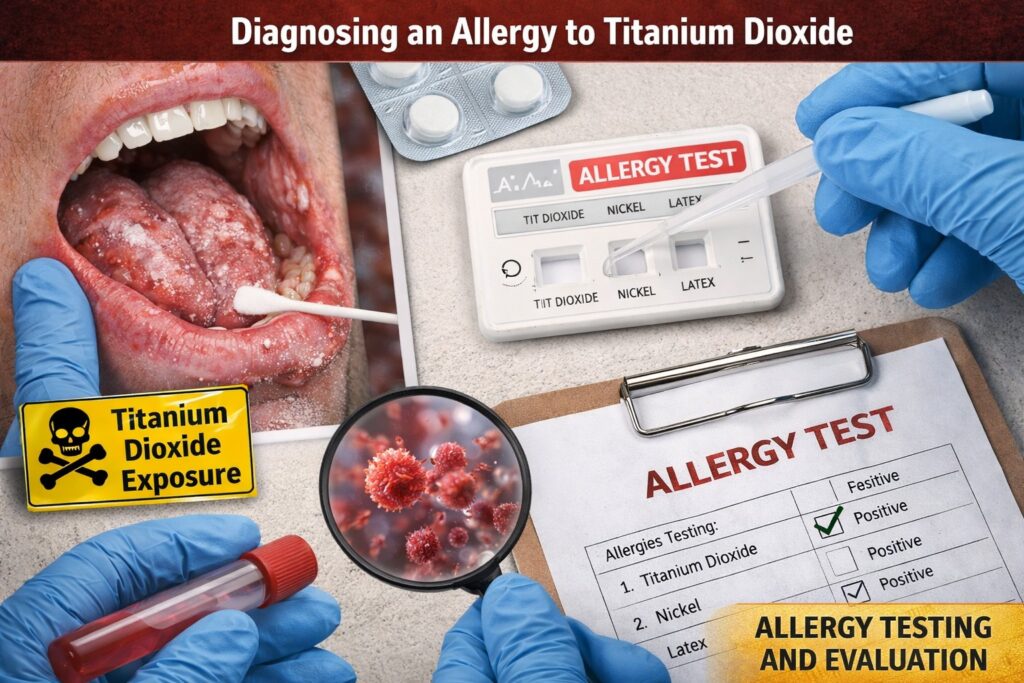
If you suspect you have an allergy to titanium dioxide based on these warning signs, proper diagnosis is essential. Unfortunately, standard allergy tests don’t always detect this type of sensitivity.
Diagnostic Approaches
Patch Testing: Dermatologists can conduct patch tests where they apply titanium dioxide to your skin under a patch for 48 hours. This helps observe any delayed reactions.
Elimination Diet: You can remove foods with titanium dioxide from your diet for 4-6 weeks. After this period, reintroduce them while monitoring for symptoms.
Product Elimination: Stop using all cosmetics, personal care products, and medications that contain titanium dioxide to see if your symptoms improve.
Blood Tests: Although not specifically for titanium dioxide, tests for inflammatory markers such as CRP and ESR can help track whether removing the compound reduces overall inflammation.
Working with Healthcare Professionals
When discussing a potential allergy to titanium dioxide with your doctor, come prepared with:
- A detailed symptom diary
- List of all products you use daily
- Food diary highlighting processed foods
- Timeline of when symptoms began
- Photos of visible reactions
Living with an Allergy to Titanium Dioxide: Practical Management Strategies
Once you’ve identified an allergy to titanium dioxide, managing it requires vigilance and lifestyle adjustments. Here’s how to minimize your exposure and protect your health.
Reading Labels Effectively
Titanium dioxide appears under several names on ingredient lists:
- Titanium dioxide
- TiO2
- CI 77891 (color index number)
- E171 (in European products)
- Pigment White 6
Pro tip: In the United States, cosmetic and food products must list titanium dioxide if present, but the amount isn’t required. “Titanium dioxide-free” or “no artificial colors” labels can guide your choices.
Safe Product Alternatives
For skincare and cosmetics:
- Zinc oxide-based sunscreens instead of titanium dioxide formulas
- Mineral makeup brands that specifically exclude titanium dioxide
- Natural, plant-based cosmetics
- DIY skincare recipes using safe ingredients
For food:
- Whole, unprocessed foods
- Organic products (which typically avoid synthetic additives)
- Products from brands committed to clean ingredients
- European imports (post-E171 ban)
For medications:
- Liquid formulations instead of tablets when possible
- Request compounded medications without titanium dioxide
- Work with pharmacists to identify titanium dioxide-free options
Kitchen and Pantry Makeover
Reducing dietary exposure to an allergy to titanium dioxide requires thoughtful grocery shopping:
- Shop the perimeter: Focus on fresh produce, meats, and dairy
- Read every label: Even “natural” products may contain it
- Avoid these common culprits: Most candy, frosted baked goods, processed cheese, and coffee creamers
- Choose wisely: Select products with short, recognizable ingredient lists
- Cook from scratch: This gives you complete control over ingredients
The Health Implications of Long-Term Exposure
Understanding the potential long-term effects of an allergy to titanium dioxide can motivate you to take your symptoms seriously and commit to avoiding this compound.
Research Findings
Recent scientific studies have raised concerns about titanium dioxide:
- Gut health: May damage intestinal lining and disrupt beneficial bacteria
- Inflammation: Can trigger chronic inflammatory responses
- DNA damage: Nanoparticles may cause oxidative stress and cellular damage
- Immune dysfunction: Chronic exposure might contribute to immune system dysregulation
While more research is needed, these findings underscore the importance of taking an allergy to titanium dioxide seriously, especially if you’re experiencing multiple warning signs.
Nanoparticles: A Special Concern
Nanoparticle forms of titanium dioxide (particles smaller than 100 nanometers) present unique risks:
- Greater skin penetration potential
- Easier inhalation into deep lung tissue
- More reactive surface area
- Potential to cross the blood-brain barrier
If you have an allergy to titanium dioxide, products containing nano-sized particles may trigger more severe reactions.
Children and Allergy to Titanium Dioxide
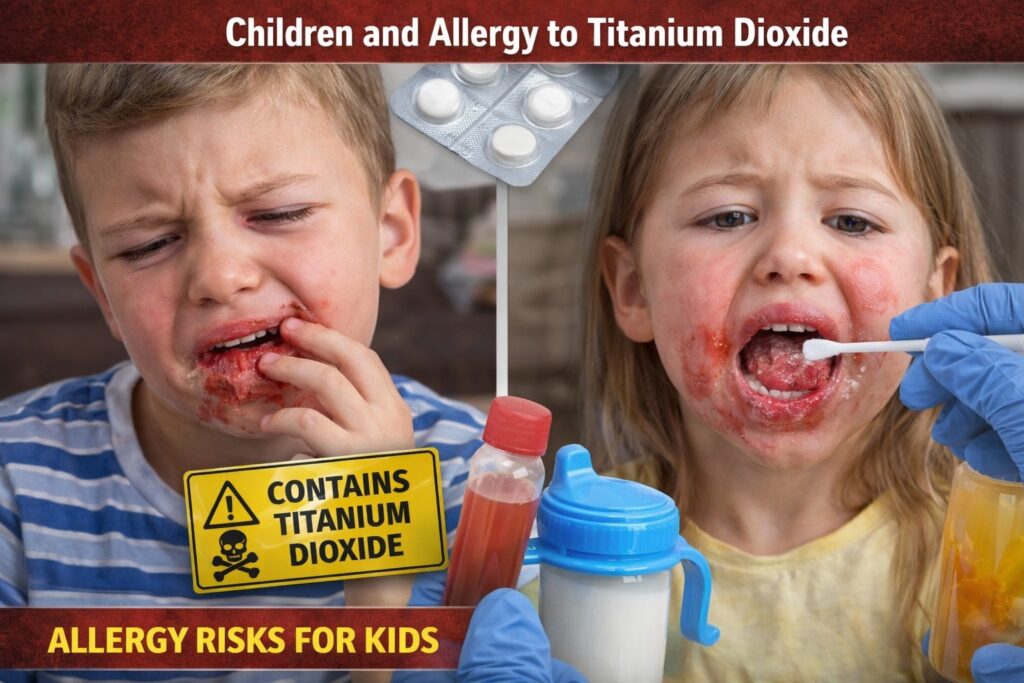
Parents should be particularly vigilant about an allergy to titanium dioxide in children, as kids are often exposed through multiple sources simultaneously.
Pediatric Considerations
Common exposure sources for children:
- Candy and sweets (high titanium dioxide content)
- Children’s toothpaste
- Sunscreen (frequently applied)
- Children’s vitamins and medications
- Arts and crafts supplies
Warning signs in children:
- Frequent stomach aches after meals
- Skin rashes, especially facial
- Behavioral changes or irritability
- Difficulty concentrating
- Chronic digestive issues
If your child shows signs of an allergy to titanium dioxide, consult with a pediatric allergist who understands chemical sensitivities. Children’s developing immune systems may be more vulnerable to these reactions.
Frequently Asked Questions About Allergy to Titanium Dioxide
| Question | Answer |
|---|---|
| Is an allergy to titanium dioxide common? | While not as widely known as other allergies, an allergy to titanium dioxide affects many people. The exact prevalence is unknown because it is often misdiagnosed or overlooked. Studies suggest that 1 to 3 percent of the population may have some degree of sensitivity. |
| Can an allergy to titanium dioxide develop suddenly? | Yes, a person can develop an allergy to titanium dioxide at any age after being exposed repeatedly. The immune system may become sensitive over time. This means you could use products safely for years before experiencing any reactions. |
| Is titanium dioxide dangerous for everyone? | Not everyone has a reaction to titanium dioxide. However, regulatory agencies like EFSA have raised concerns about its safety for the general population. This has resulted in bans in some areas. People with an allergy to titanium dioxide should be especially careful. |
| How long does it take for symptoms of allergy to titanium dioxide to appear? | Not everyone has a reaction to titanium dioxide. However, regulatory agencies like EFSA have raised concerns about its safety for the general population. This has resulted in bans in some areas. People with an allergy to titanium dioxide should be especially careful. |
| Can I still eat at restaurants if I have an allergy to titanium dioxide? | Dining out with a titanium dioxide allergy can be tough. Restaurants usually don’t tell you about their additives. Choose places that make food from scratch. Stay away from creamy sauces and processed items. Don’t be afraid to ask about the ingredients. |
| Are there any safe forms of titanium dioxide? | If you are allergic to titanium dioxide, you should avoid all kinds of it, including food-grade, cosmetic-grade, and nanoparticle forms. There is no “safe” version for someone with this allergy, though some people may respond more severely to specific types. |
| How can I tell if my medication contains titanium dioxide? | Check the inactive ingredients list on medication packaging or ask your pharmacist. If you are allergic to titanium dioxide, inform all your healthcare providers. You may need to request compounded versions of medications. |
| Will my allergy to titanium dioxide go away over time? | Unfortunately, allergies and sensitivities usually don’t go away on their own. However, completely avoiding triggers may lower your body’s reaction level over time. Some people notice that their symptoms improve significantly after years of strict avoidance. |
| Can breast milk contain titanium dioxide if a mother consumes it? | Research shows that nanoparticles, including titanium dioxide, may transfer through breast milk. Nursing mothers who think their infant might be allergic to titanium dioxide should think about removing it from their diet. |
| Are natural or organic products always free of titanium dioxide? | Not necessarily. “Natural” and “organic” labels don’t ensure that titanium dioxide is absent. Always read the ingredient lists closely. Look for “titanium dioxide-free” certifications if you have an allergy to titanium dioxide. |
Taking Action: Your Next Steps
If you recognize multiple warning signs of an allergy to titanium dioxide in yourself or a loved one, taking action is crucial for improving your health and quality of life.
Immediate Steps
- Document your symptoms: Keep a detailed journal tracking symptoms, products used, and foods consumed
- Audit your products: Go through every cosmetic, personal care item, medication, and frequently consumed food in your home
- Start eliminating: Remove obvious titanium dioxide sources and monitor symptom changes
- Seek professional help: Schedule appointments with an allergist, dermatologist, or integrative medicine practitioner
Long-Term Strategies
Build a support network: Connect with others who have an allergy to titanium dioxide through online communities and support groups.
Stay informed: Research is ongoing regarding titanium dioxide safety. Subscribe to consumer safety organizations and advocacy groups for updates.
Advocate for yourself: Don’t hesitate to request titanium dioxide-free alternatives from manufacturers, healthcare providers, and restaurants.
Educate others: Share your knowledge about an allergy to titanium dioxide with friends, family, and healthcare providers who may be unaware of this condition.
The Future of Titanium Dioxide Regulation
With the growing awareness of the possible risks associated with titanium dioxide, the regulations are undergoing a shift. The ban on E171 in the European Union regarding food products is a significant step towards safeguarding consumers.
In the United States, consumer organizations are calling for the FDA to reassess the GRAS status of titanium dioxide. For people with an allergy to titanium dioxide, this is long overdue.
However, some forward-thinking companies are now reformulating their products to eliminate titanium dioxide in response to consumer demand for cleaner and safer ingredients.
Conclusion: Empowering Yourself Against Allergy to Titanium Dioxide
Recognizing the warning signs of an allergy to titanium dioxide is the first critical step toward reclaiming your health. From persistent contact dermatitis and digestive disturbances to respiratory issues and systemic inflammation, these 10 warning signs provide a roadmap for identifying whether this ubiquitous compound is affecting your wellbeing.
Living with a titanium dioxide allergy necessitates constant attention, but it is completely manageable with the right information and resources. You can significantly reduce your exposure and symptoms by reading labels carefully, choosing whole foods over processed options, using titanium dioxide-free personal care products, and working with knowledgeable healthcare providers. Keep in mind that you are not alone on this journey. As more people become aware of an allergy to titanium dioxide and demand safer alternatives, the marketplace is responding with cleaner, more transparent products. Your commitment to understanding and managing this condition not only benefits your own health but contributes to broader consumer safety awareness.
Take action today: Review the products in your home, start a symptom diary, and consider scheduling an appointment with a healthcare provider who understands chemical sensitivities. Your body has been sending warning signals—now you have the knowledge to interpret and respond to them effectively.
The path to better health starts with awareness, and you’ve taken that crucial first step by educating yourself about an allergy to titanium dioxide. Don’t settle for feeling sick when the solution might be as simple as removing this one compound from your life. Instead, trust your symptoms and advocate for your needs.